From the moment the vessel berths until the container is in the warehouse, four parties must all give the “green light”: the shipping line, customs, the port and the transport company. If any one of them is not ready, a truck already at the port gate has to turn back. This article walks through each step of an import container haul, the documents needed at each step and what the receiving warehouse should prepare in advance.
1 Four Conditions for a Truck to Collect a Container at the Port
| Condition | Documents | Issued by |
|---|---|---|
| Shipping line releases the cargo | Delivery order (D/O), now mostly electronic | The shipping line or forwarder, after local charges are paid and the original bill of lading is surrendered or telex release is confirmed |
| Customs clears the goods | Declaration cleared or goods released; container on the list eligible to pass the customs control area | Customs, via the electronic declaration system |
| Port allows the container to be lifted | Container release registration, lift-on fee invoice, equipment interchange receipt (EIR) | The port — at Cat Lai done on the port's online portal |
| Valid truck and driver | Registered truck and trailer plates and driver details; letter of introduction when required | Transport company |
The order above is also the order to work in. The delivery order and customs documents can be prepared before the vessel berths; if you wait until it arrives, most of the free time passes while waiting for paperwork — how free time is counted and why every day of delay costs money is explained in DEM, DET, Storage and free time.
2 The Eight Steps of an Import Container Haul
- Step 1 — Receive the arrival notice. The shipping line or forwarder sends the expected berthing date, container numbers and local charges payable.
- Step 2 — Obtain the delivery order and pay the container deposit. Pay local charges, surrender the original bill of lading (or have telex release), and pay the container deposit if the shipping line requires. Note that the delivery order has a validity period, usually tied to free time.
- Step 3 — Declare and clear. Transmit the declaration, handle the channel result and pay duties. Do this in parallel with step 2, not after it — see how to prepare documents under our customs declaration service.
- Step 4 — Register for container release at the port. Register the release, pay lift-on and any port storage fees, and receive the equipment interchange receipt.
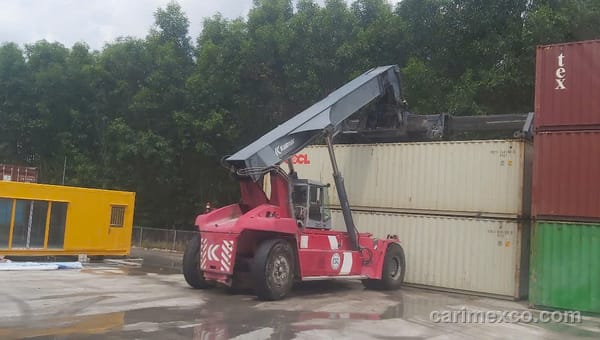
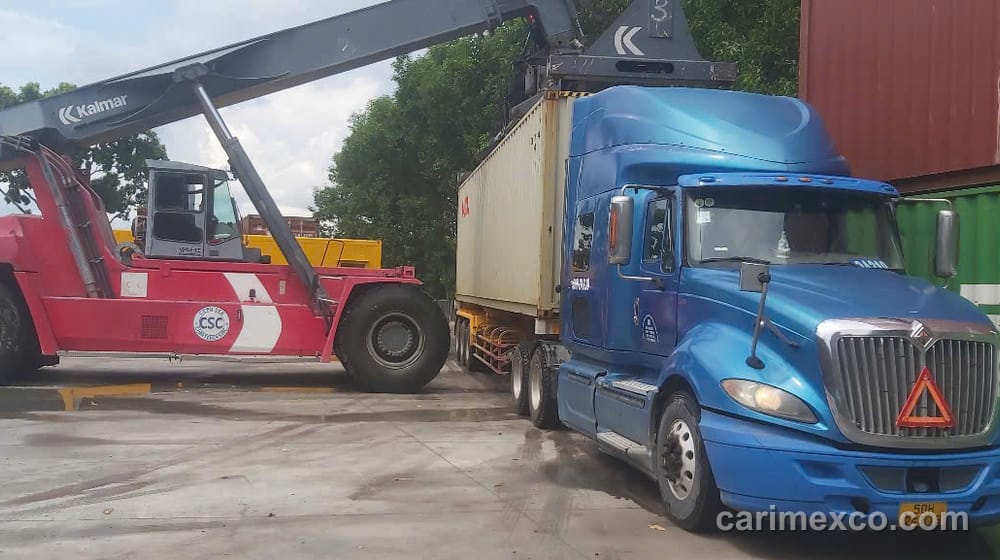
- Step 5 — The truck collects the container. The driver presents the receipt, has the container loaded onto the trailer, and checks the container number, seal and condition before leaving the yard.
- Step 6 — Pass the control gate. An eligible container is let through the gate out of the port area under customs supervision.
- Step 7 — Drive to the warehouse and unload. The warehouse receives the container, unloads it and records any damage or shortage.
- Step 8 — Return the empty. The truck takes the empty to the depot designated on the delivery order and receives a return receipt — the basis for the deposit refund and checking detention charges.
For customers in Dong Nai, CARIMEX provides import container trucking from Cat Lai, Cai Mep and Phuoc An to industrial parks, dispatching from the Nhon Trach yard so trucks reach the port early with less empty running.
3 What to Check When Collecting a Container at the Port
Five minutes of checks in the port yard prevent days of disputes later:
- Container and seal numbers match the delivery order and bill of lading. A wrong or broken seal must be reported immediately — do not haul the container away.
- Container condition — dents, holes, stuck doors, damaged floor. Existing damage must be noted on the interchange receipt before leaving the gate; otherwise it is easily blamed on the cargo owner when the empty is returned.
- Cargo weight against the permitted load of the truck combination — for a 20-foot container of heavy cargo, this must be settled when booking the truck.
- Reefer containers — set temperature, unit status, and whether power is needed en route or at the warehouse.
4 What the Receiving Warehouse Should Prepare
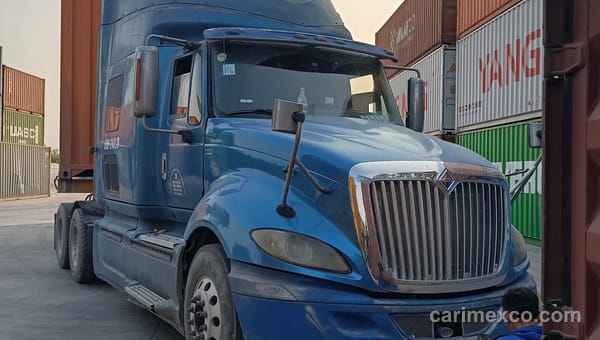
- Access road and turning space. A tractor hauling a 40-foot container is about 16–17 m long and needs a wide enough road and room to turn; say in advance if the access road has weight, height or time restrictions.
- Labour and unloading equipment ready when the truck arrives. Unloading beyond the agreed free time incurs truck waiting charges.
- Someone to sign and a delivery record noting the seal condition when cut.
- A fallback if unloading cannot be done in time — leave the trailer at the warehouse to unload gradually, or take the container to an off-port yard to unload and then return the empty.
5 How Long the Whole Process Takes
With documents prepared in advance, a green channel declaration can be cleared and the container collected on the same day discharge is completed. The yellow channel usually adds one to a few working hours for explanations; the red channel adds time to arrange inspection, usually measured in days. The run from Cat Lai to industrial parks in Dong Nai and Binh Duong takes about 1–2.5 hours depending on the delivery point and truck restriction hours; longer routes are in the route table of our road container transport service.
Most delayed hauls are not delayed by distance, but because one of the four conditions in section 1 is not met when the truck reaches the gate. If you are already in that situation, how to find the bottleneck is covered in cargo has arrived but the container cannot be collected.
Send the bill of lading number and expected vessel date — CARIMEX handles the delivery order, declaration, container release registration and truck dispatch through a single point of contact, with updates at each milestone. Call +84 933 968 988.